
Martingale Roulette Strategy: Understanding the Progressive Betting System That Promises Loss Recovery
If you’ve spent any time around casinos or online gambling forums, you’ve probably heard whispers about the Martingale betting system. This legendary progressive betting strategy has captivated gamblers for centuries with its seemingly foolproof logic: simply double your bet after each loss, and eventually, you’ll recover everything. But does this double bet after loss method actually work, or is it just another path to emptying your bankroll? Let me walk you through everything you need to know about this famous roulette betting pattern.
TL;DR Summary
The Martingale roulette strategy involves doubling your bet after every loss on even money bets like red or black. While it can produce short-term wins, mathematical expectation, table limits, and bankroll requirements make it a risky long-term approach that doesn’t overcome the house edge despite its appealing recovery betting logic.
Martingale Betting System Origins and Historical Context

The Martingale system traces its roots back to 18th-century France, though its exact origins remain debated among gambling historians. Some attribute the strategy’s name to John Henry Martindale, a London casino owner who encouraged players to “double or nothing,” while mathematician Paul Pierre Levy later formalized the concept within probability theory. Originally applied to coin-flipping games, the system naturally migrated to roulette tables in establishments like Monte Carlo Casino, where even money wagers on red and black betting became the perfect testing ground for this negative progression approach.
Progressive Betting Mechanics Explained Through Probability Theory
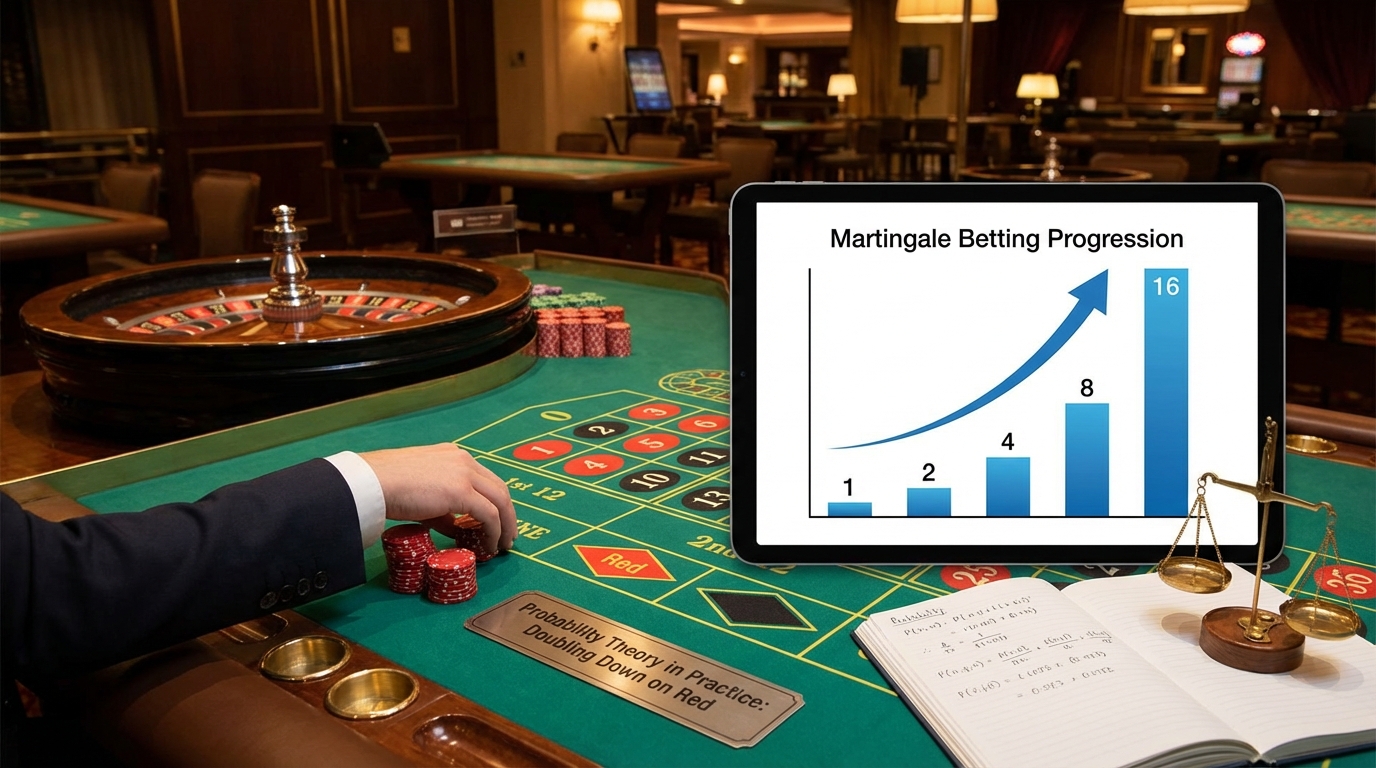
At its core, the Martingale strategy operates on straightforward mathematics. You start with a minimum bet on any even chance bets—typically red or black, odds and evens, or high and low. If you lose, you double your previous stake. If you win, you return to your original betting unit size. This betting progression creates a scenario where a single win theoretically recovers all previous losses plus your initial bet amount, making it an appealing loss recovery system for those seeking systematic betting approaches.
How Does the Betting Progression Chart Actually Work?
Let me illustrate this with a practical example. Starting with a $5 bet on red, your betting sequence would look like this: $5, $10, $20, $40, $80, $160, $320, and so forth after consecutive losses. Notice how the stakes grow exponentially—this geometric sequence betting pattern means your seventh bet requires $320 to potentially win back $325 total, representing only a $5 net profit despite risking substantial capital. This exponential growth is both the system’s appeal and its greatest vulnerability.
Roulette Variations Impact House Edge and Expected Value
Understanding how different roulette wheels affect your strategy effectiveness is crucial for realistic expectations. European Roulette features a single zero, giving the casino a 2.7% house edge on even money bets. American Roulette adds a double zero, increasing the casino advantage to 5.26%. French Roulette offers the best odds with the “la partage” rule, effectively cutting the house edge to 1.35% on outside bets. Regardless of which variant you choose, the mathematical expectation remains negative, meaning the casino maintains a statistical edge that no betting system can overcome through bet multiplication alone.
Why Do Table Limits Destroy Martingale Strategy Effectiveness?
Here’s where theory crashes into reality. Every casino implements maximum bet limits specifically to counter progressive betting systems. If you start with a $5 minimum bet and encounter a typical $500 maximum bet table, you can only sustain seven consecutive losses before hitting the ceiling. These betting limits impact your ability to complete the progression, turning what seemed like a guaranteed recovery system into a capital requirements nightmare. The probability of seven straight losses on even money wagers sits around 0.78%, which seems rare until you consider how many spins occur during gambling sessions.
Bankroll Requirements and Risk of Ruin Analysis
Let’s talk about the elephant in the casino—money. To safely execute a Martingale approach, you need substantial bankroll management and capital that most recreational gamblers simply don’t possess. For a conservative approach allowing ten consecutive loss coverage with $5 starting bets, you’d need $5,115 in available funds. That’s serious money to risk for winning $5 per successful cycle. The risk of ruin calculations reveal that even with adequate capital, extended playing sessions virtually guarantee encountering a losing streak that either exhausts your bankroll or hits table maximum limits before recovery becomes possible.
What Are Realistic Bankroll Requirements for Safe Implementation?
Financial experts and gambling mathematics suggest maintaining at least 255 times your base betting unit to survive expected variance. For our $5 example, that’s $1,275 minimum, though this still doesn’t eliminate ruin probability. Conservative martingale roulette approach advocates recommend even higher reserves—500 to 1,000 times your starting bet. These capital requirements explain why the system appeals more to theoretical discussion than practical application for average casino visitors with limited session bankrolls.
Common Martingale Variations and Alternative Betting Systems
Recognizing the standard system’s flaws, gamblers developed numerous modifications. The Grand Martingale adds your original bet to each doubled wager, accelerating both potential profits and catastrophic losses. The Mini Martingale caps your progression at a predetermined level, limiting damage but abandoning the recovery guarantee. Meanwhile, the Reverse Martingale or Anti-Martingale flips the script entirely—you double after wins instead of losses, attempting to capitalize on winning streaks while limiting exposure during losing streaks through positive progression rather than negative progression.
How Do Alternative Systems Like Fibonacci and D’Alembert Compare?
Other betting methodology options offer gentler progressions than Martingale’s aggressive stake doubling. The Fibonacci system follows the famous mathematical sequence (1, 1, 2, 3, 5, 8, 13…), creating slower growth that extends bankroll longevity. The D’Alembert system increases bets by one unit after losses and decreases by one after wins, representing an arithmetic progression rather than geometric sequence betting. The Labouchere system uses a cancellation method, while the Paroli system limits consecutive win doubling. Each alternative addresses different aspects of risk management, though none overcome the fundamental house edge that probability mathematics dictates.
Mathematical Expectation Proves Long Term Outcomes
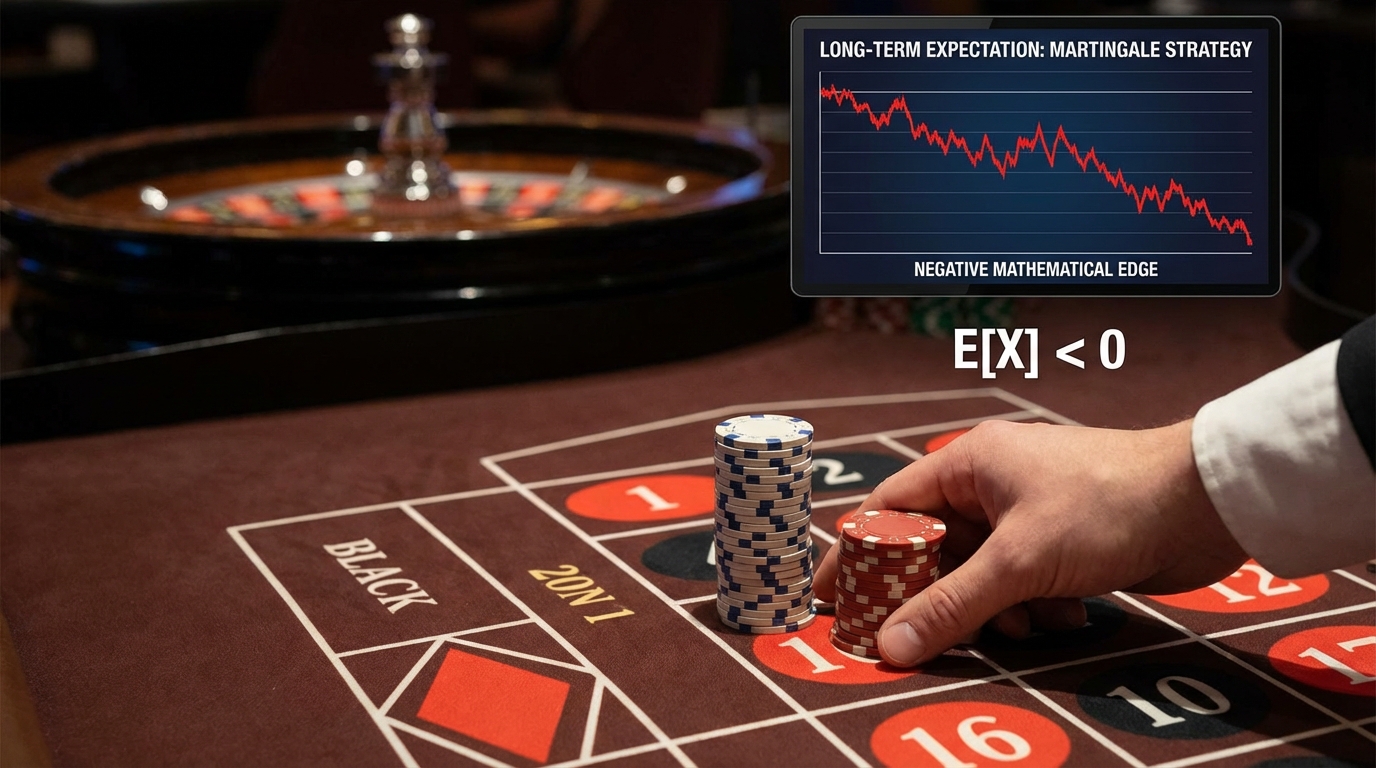
Here’s the hard truth backed by probability theory and Monte Carlo simulation: the Martingale strategy doesn’t change your expected value—it only redistributes variance and risk patterns. Whether you flat bet or use progressive wagering, the house edge remains constant on every independent spin. Random number generator systems and physical roulette wheels both produce outcomes where past results don’t influence future spins, making the gambler’s fallacy—believing red becomes “due” after multiple black results—a dangerous psychological trap that this betting psychology strategy inadvertently encourages.
| Betting Approach | Risk Level | Win Frequency | Win Size | Loss Size |
|---|---|---|---|---|
| Flat Betting | Low | ~48% | 1x bet | 1x bet |
| Standard Martingale | Very High | ~98%+ short-term | 1x original bet | 127x+ original bet |
| Modified Martingale | High | ~92% | 1x original bet | 31x original bet |
| Reverse Martingale | Medium | ~48% | Variable (large) | 1x bet |
What Does Statistical Analysis Reveal About Strategy Success Stories?
When you examine martingale roulette strategy success stories versus failure examples, a pattern emerges. Winners typically played short sessions, got lucky avoiding extended losing streaks, and—crucially—stopped playing while ahead. The strategy effectiveness appears higher in limited samples due to short term variance, but long term expectation inevitably trends toward the mathematical reality. Standard deviation and outcome prediction models consistently demonstrate that the system transforms many small wins into occasional massive losses, creating a high-variance approach that feels successful until it suddenly isn’t.
Casino Countermeasures and Legal Considerations
Casinos aren’t oblivious to betting theory and systematic betting approaches. Besides implementing betting range restrictions through minimum bet requirements and table maximum impact limits, many establishments actively monitor betting patterns for progressive systems. However, using the Martingale strategy remains perfectly legal—casinos simply don’t fear it because the mathematics work in their favor. Whether you’re playing at Las Vegas establishments, online casino platforms, or live dealer roulette, the house edge and probability distribution ensure casino profitability regardless of your betting methodology.
How Do Online Casinos and RNG Roulette Affect Strategy Viability?
Online roulette presents unique considerations for Martingale practitioners. RNG roulette uses algorithms tested for randomness, producing truly independent trials without physical wheel bias possibilities. Many online platforms offer lower minimum bet requirements, allowing more progression steps before hitting maximum exposure, but also feature wider betting limits that seem accommodating until you’re deep into a sequence. Live dealer roulette combines real wheels with online convenience, though the fundamental probability calculation remains unchanged. Some players believe online environments accelerate play enough to encounter ruinous losing streaks faster than brick-and-mortar casinos.
Practical Advice for Responsible Strategy Implementation

If you’re determined to test this system despite its mathematical disadvantages, implement strict money management rules. Set absolute stop loss limits before starting—perhaps three to five betting cycles. Establish profit targets and walk away when reached. Never chase losses beyond your predetermined session bankroll. Consider the conservative martingale approach where you cap progression at four or five doublings regardless of outcome. Remember that gambling strategies should enhance entertainment, not serve as income generation methods. Session management and betting discipline matter far more than which wagering progression you choose.
- Start with the absolute minimum bet allowed to maximize progression potential
- Only play European or French Roulette to minimize house edge impact
- Bring exactly your predetermined bankroll—leave cards and additional cash elsewhere
- Track consecutive losses and establish a hard stop at five or six losses maximum
- Never borrow money or dip into funds designated for other purposes
- View any winnings as entertainment value rather than profit generation
What Are the Biggest Martingale Strategy Common Mistakes?
The most dangerous error is believing you’ve discovered a casino-beating secret. Other common mistakes include insufficient bankroll preparation, ignoring table limit realities, continuing beyond rational stop points during losing streaks, and falling victim to the sunk cost fallacy—thinking you must continue because you’ve already invested so much. Many players also make the mistake of applying Martingale to inside bets like straight up bet or corner bet options where odds don’t support even the theoretical recovery mechanism that makes the system work on even chance betting.
The Verdict on Martingale Strategy Effectiveness
After examining the betting progression chart, probability mathematics, and real-world constraints, the conclusion becomes clear: the Martingale roulette strategy cannot overcome the house edge or transform a negative expectation game into profitable long-term investment. It can provide structured betting discipline and occasional winning sessions, but mathematical proof consistently demonstrates that risk reward ratio heavily favors catastrophic loss over sustained success. The system’s appeal lies in its simplicity and short-term win rate, creating an illusion of effectiveness that game theory and expected value calculation thoroughly debunk. Understanding these realities helps you make informed decisions about whether this classic betting methodology fits your gambling entertainment approach.
Frequently Asked Questions
Does the Martingale roulette strategy actually work in real casinos?
The Martingale strategy can produce short-term wins and many successful sessions, but it mathematically cannot overcome the house edge long-term. Table limits and bankroll constraints prevent the system from guaranteeing profit, and extended play inevitably leads to encountering a losing streak that either exhausts your funds or hits the maximum bet ceiling. While legal and temporarily effective, it’s not a reliable profit-generation method.
How much money do I need to safely use the Martingale strategy?
Conservative estimates suggest having 255-500 times your base betting unit to withstand expected variance. For a $5 starting bet, this means $1,275-$2,500 minimum. However, even substantial bankrolls don’t eliminate the risk of ruin—they only extend how long you can play before encountering a catastrophic losing streak. Most experts recommend having enough to cover at least 8-10 consecutive losses comfortably.
Why do table limits make Martingale strategy fail?
Casinos implement maximum bet limits specifically to counter progressive betting systems. After just 7-8 consecutive losses starting with a $5 bet, you’d need to wager $640-$1,280 to continue the progression. Most tables cap maximum bets at $500-$1,000, preventing you from placing the next required bet and completing the loss recovery sequence. This transforms the theoretical “guaranteed” recovery into an impossible situation.
Is European roulette better than American roulette for Martingale strategy?
Yes, European roulette is significantly better due to its single zero giving a 2.7% house edge versus American roulette’s double zero creating a 5.26% edge. French roulette is even better with rules like “la partage” reducing the edge to 1.35% on even money bets. While these differences don’t make Martingale profitable long-term, they do improve your odds and extend expected playing time before encountering ruinous losses.
What’s the difference between Martingale and Reverse Martingale strategies?
Standard Martingale doubles bets after losses (negative progression) attempting to recover all previous losses with one win. Reverse Martingale or Anti-Martingale doubles bets after wins (positive progression) trying to maximize winning streaks while keeping losses small. The reverse version limits risk by only increasing stakes with house money during hot streaks, though neither system changes the fundamental house edge or expected value over time.
Can online roulette detect and prevent Martingale betting patterns?
Online casinos can track betting patterns but don’t typically prevent Martingale use because it doesn’t threaten their profitability—the house edge and table limits protect them mathematically. Some platforms may flag unusual betting activity for bonus abuse concerns, but using Martingale with real money remains completely legal and unrestricted. The RNG systems ensure truly random independent spins that make the strategy equally ineffective as physical wheels over sufficient sample sizes.